
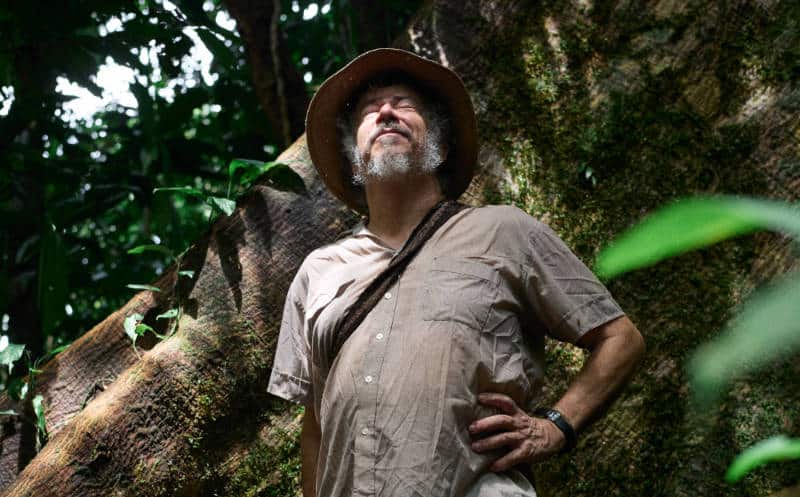
Storytelling has the power to reveal the soul of a place. Few understand this better than Stavros Habakis, an award-winning visual storyteller whose cinematic work has helped capture the essence of some of the world’s most remarkable hospitality destinations.
In this thoughtful interview, Stavros speaks with Diego Samper, founder of Calanoa, whose vision has helped shape a place where hospitality, art, nature, and conservation meet in meaningful harmony.
Through questions rooted in curiosity and sensitivity, the conversation explores the philosophy behind Calanoa, the wisdom of the forest, cultural reverence, and the possibility of living more gently within the natural world.
We are honored to share this dialogue with you, and grateful to Stavros for creating space for the spirit of Calanoa to be expressed through Diego’s wise words.
STAVROS HABAKIS
1. What was the first moment when the Amazon “called” you to create Calanoa?
Since I was a kid, I wanted to be an adventurer and to live in the wild. At fourteen years old I went for the first time to the Orinoco River, and then I was certain about it. Ever since, I have been faithful to my dream.
2. What is the philosophy behind Calanoa in one sentence?
Calanoa is a place of encounters, with the Wild, with the Other, with yourself. As a project, it’s a laboratory of design for inhabiting in a gentle way the Amazon Forest.
3. In your view, what does it mean for a human to “breathe with the forest”?
To breathe, to listen to the beat of the forest, to feel the pulse of Life, is to understand that the skin is not the frontier between the outer world and our inner existence, that we are the forest and that the forest inhabits our soul.
4. Do you believe the Amazon teaches us, shapes us, or transforms us? How?
It is certainly an old master. Amazonian elders talk to the trees and medicinal plants asking for council. The quiet contemplation of nature and embracing it with awe is a way of knowledge.
Even a short stay can be profound and transformative. When you arrive here, immersed deep in hundreds of square kilometers of pristine forest, your body recognizes the ancient connection with the Wild.
5. How has working with local communities shaped the identity of Calanoa?
Since the beginning, creating Calanoa has been a joint venture with the local communities. And as a conservation project, the cultural component is as essential as the environmental one.
6. What is one lesson you learned from the Indigenous elders that changed the way you see life?
The first indigenous mentor I had was a Cubeo shaman who was teaching me how to weave baskets. With him I learned that nature is a single beating tissue of life, where everything is connected, and that our own existence is a continuous weaving of relationships and affections.
7. How do you ensure that Calanoa contributes to cultural regeneration rather than cultural extraction?
Our relationship with the place and cultures is based on respect, and in the recognition that the Amazonian cultures are the result of a long and profound dialogue with the landscape we inhabit. We enhance cultural expressions and the restoration of traditional lore.
8. What does sustainability mean here — beyond the word itself?
It is more the concept of autarchy, of self-sufficiency, of solving in a creative way all the challenges of living in the tropics with what you have at hand: local materials and local wisdom.
9. How can hospitality become a regenerative force in the Amazon?
We conceived the lodge as part of the conservation project that is Calanoa. It generates a local economy that is based on conservation and restoration of the territory and its local cultures. Respect and support of the indigenous identity is on its essence, as is the scale of settlement, small and light.
10. Can a traveler leave the forest better than they found it? In what ways?
A conscious traveler leaves no prints. On the other hand, in a journey of discovery and exploration it is the traveler who leaves transformed, in awe of the life forces that emanate from this gigantic being.
11. When a guest arrives here, what do you hope they feel first?
Actually, since the beginning we invite visitors to open their senses, to observe and listen deeply, to explore novel aromas and flavours. Our kitchen is devoted to that, as is the garden and art all around the place.
12. How do the rituals — smoke, blue mud, lake, community — shape the emotional journey of the guests?
These are rituals that have been used for millennia to pay reverence to the place and its vital forces, and to restore our natural balance. Long ignored by us, we are starting to understand the value and power of these ancient traditions. In our blind push into the future, we have forgotten to look back at our origins and the wisdom that lays at the sources.
13. Have you ever felt that the forest “spoke back” to you?
Yes, more than once. When you stop thinking with words, when in silence you acknowledge the presence of this ancient forest, you start to listen to it, and that way to know it on its essence.
Calanoa means the place where the spirit of nature is manifested, and here, if you listen with your soul, you can hear its gentle humming.
14. What does silence means here?
Well, it’s allowing our senses to perceive without the interference of our rational mind.
A silent consciousness listening to the Wild Symphony outside, because the forest is never silent, is singing and humming and beating.
15. If you had to give one message from the forest to the world, what would it be?
The lesson that we can learn from the natural history of the Amazon Forest, by far the most extraordinary story of evolution and transformation, is that life thrives through cooperation more than competition. Life in the planet, and that includes the human species, is a single living skin covering a rock that spins endlessly into the infinite Cosmos.
16. If Calanoa were a story, what would be its final sentence?
And then, it started to rain, gently, while the sun was still shining through the canopy. Raindrops like tears falling from the sky, drops of hope, as the rain has always been.